Product Design
Design Subscription vs Agency vs In-House: A SaaS Buyer’s Guide
A decision table for choosing between a design subscription, an agency project and an in-house designer, with dated costs and shortlist questions.

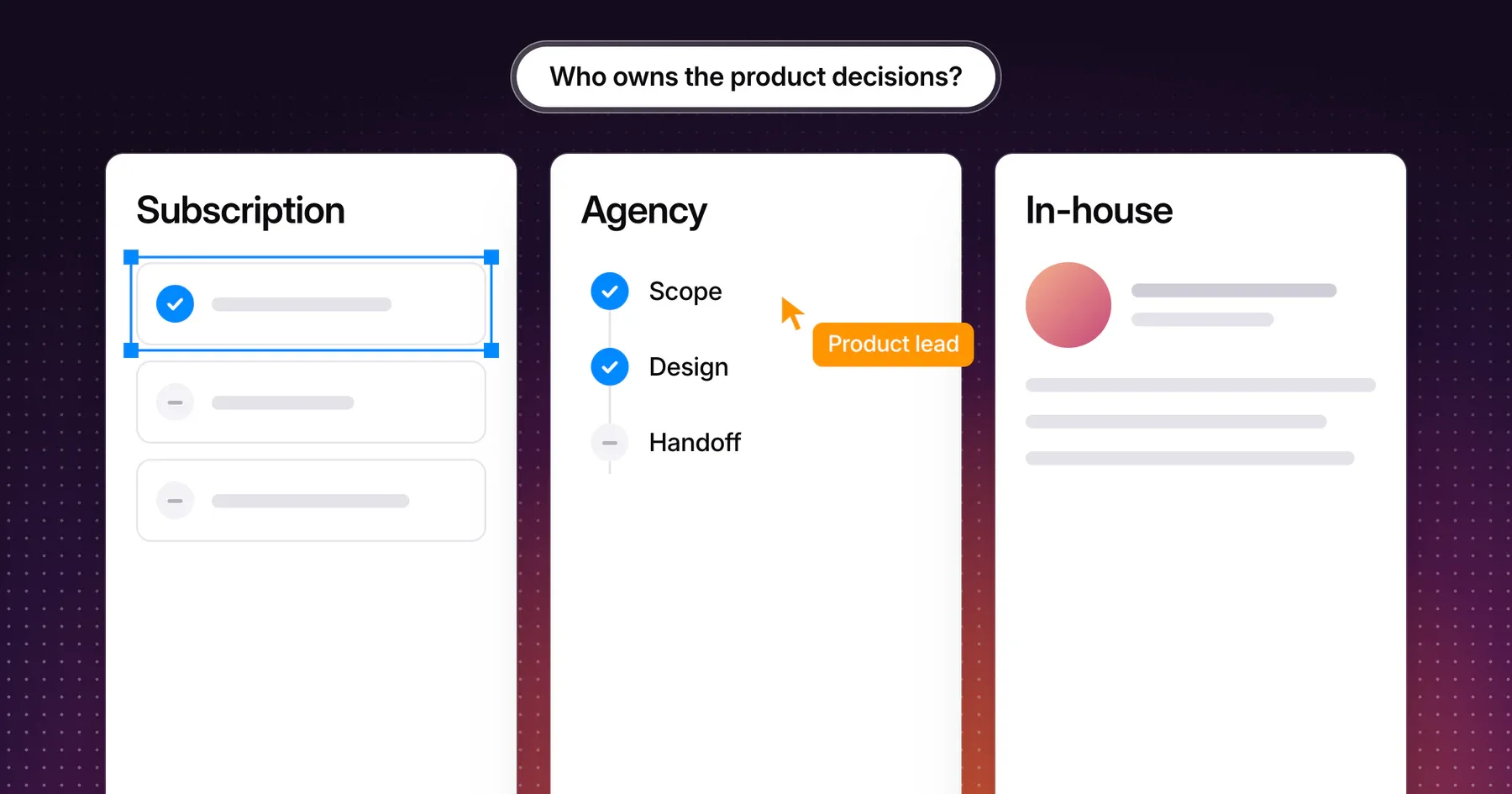
Choose a design subscription when you have a steady queue of well-defined design tasks and someone on your team can direct them. Choose an agency when the work has a clear boundary, such as a redesign with an end date. Hire in-house when product design is continuous enough to fill a full-time role and you want one person accountable for product decisions over several years.
Cost separates the three quickly. On November 8, 2026, published subscriptions ranged from about $700 to $5,000 a month, UI/UX agencies at the top of Clutch’s directory set project minimums from $5,000 to $50,000, and a US web and digital interface designer cost about $12,400 a month once benefits were included. Each figure buys something different, so the useful comparison starts with the work you need done.
This guide is for founders and product leaders staffing design at a SaaS company. Gestures sells a monthly partnership and weekly sprints, so we have a stake in this comparison. The tables include the cases where our model is the wrong choice. Providers differ, so read the terms of any plan you shortlist.
Compare the three models at a glance
| Question | Design subscription | Agency project | In-house designer |
|---|---|---|---|
| What you buy | A queue of design work for a monthly fee | A defined outcome for a quoted scope | One person’s working time and growing product knowledge |
| Best fit | Steady requests that are already well defined | A bounded project with a clear end | Continuous product work that fills a full-time role |
| Poor fit | Work where the first job is deciding what to build | Small, shifting requests that never justify a scope | Uneven workload, or a need for help this month |
| Who owns product decisions | Your team | Shared, as the proposal defines | The designer, with product leadership |
| Your management work | Writing, ordering and reviewing every request | Consolidating feedback and approving milestones | Hiring, onboarding, direction and career growth |
| How it ends | Pause or cancel under the provider’s terms | The contract ends with agreed deliverables | Notice, handover and the cost of replacing the role |
Separate production throughput from product ownership
Most poor choices come from buying throughput when the team needs ownership. Throughput is how many well-defined design tasks get finished. Ownership is deciding which problem matters, which tradeoffs are acceptable and who stays accountable after the feature ships.
“Design a filter panel for the accounts table” is a throughput request. “Customers cannot find the accounts that need attention” is an ownership problem, because someone has to investigate it before anyone knows a filter panel is the answer.
Subscriptions are built around throughput, and their limits show it. Designjoy delivers one request at a time from your queue. ManyPixels explains that its unlimited requests are limited in practice by a designer’s daily output. Neither limit is a flaw if your work arrives as clear, separate tasks.
Try this test on your next three design needs. Write each one as a request. If it fits in a paragraph with a clear output, it is throughput work. If you need a meeting before you can write it, it is ownership work, and a queue will return it to you unresolved.
Compare what each model costs
| Option | Published figure | What it covers |
|---|---|---|
| ManyPixels subscription | $699 to $2,599 per month, billed monthly | One daily output up to two part-time designers. Its pricing page lists web design and does not list UI/UX |
| Designjoy subscription | $4,995 per month | One request at a time, including Webflow development |
| UI/UX agency on Clutch | $5,000 to $50,000 minimum project; $25 to $199 per hour | Agencies at the top of the Clutch UI/UX directory |
| US in-house designer | About $12,400 per month | Median pay plus benefits, before recruiting, equipment and software |
| Gestures partnership or sprint | $7,500 per month, $2,250 per week or $4,000 for two weeks | A Lead Designer, a Senior Designer and an Account Manager |
Prices as listed on November 8, 2026.
The in-house figure starts with the $104,000 median pay for web and digital interface designers in May 2025. Benefits were 30.0% of private-industry compensation in June 2026, so $104,000 divided by 0.70 comes to about $148,600 a year. It is a national median across seniority levels, so adjust it for the role and location you are hiring in.
Over 12 months, $4,995 a month comes to $59,940 and $7,500 a month comes to $90,000. Those totals sit below the in-house figure, but an employee gives you a full working week and a subscription gives you a place in a queue. Compare each price against the weeks of work you actually need.
Compare ongoing work with a bounded project
If you can write an end date and acceptance criteria, you have a project. If next quarter’s priorities depend on what you learn this quarter, you have ongoing work.
An agency suits the first case because a fixed scope gives both sides a boundary. A marketing site rebuild is a good example, and the website redesign scope and cost guide shows how to compare those quotes line by line. The same structure works against you when priorities move every two weeks, because each change reopens the scope.
In-house suits the second case once the work is large enough. As a working rule, hire when you can list a full year of product work that needs one person’s attention. Below that level, a designer may run out of high-value work or spend their time on tasks that do not need them.
Between those two sits an ongoing product design collaboration: a small senior team that stays with the product across several months and shares the problem-framing work, without the commitment of an employee. It costs more than a production queue and it still needs a decision maker on your side.
Account for management and handoff responsibilities
Every model needs someone at your company who makes product decisions. If nobody can review work each week, none of the three will deliver. Estimate those hours before comparing prices, and put a name beside them.
| Responsibility | Design subscription | Agency project | In-house designer |
|---|---|---|---|
| Writing the brief | Your team, for each request | Shared at kickoff | The designer, with product input |
| Research and user access | Usually your team | Only if scoped | The designer |
| Keeping the design system current | Only if requested | Only if scoped | The designer |
| Engineering handoff | Files you request | The deliverables in the contract | Daily collaboration |
| Checking the built product | Usually your team | Only if scoped | The designer |
| Keeping product knowledge | Lives in your files and requests | Leaves when the project ends unless documented | Stays while the person stays |
Ask where files live and who controls them before work begins. ManyPixels states on its pricing page that source files and copyright transfer to the client. Other providers may handle this differently, so get the answer in writing.
Choose a model with three questions
Answer these in order and stop at the first yes.
| Question | If yes | If no |
|---|---|---|
| Can you list a full year of product design work for one person? | Hire in-house, and use outside help while you recruit | Go to the next question |
| Can you write an end date and acceptance criteria for this work? | Scope a project with an agency or a short sprint | Go to the next question |
| Can someone write clear requests and review work every week? | A subscription or ongoing partnership can work | Name a product owner first, because outside design will stall without one |
You can combine models. An in-house lead with an external team for peak periods keeps ownership inside the company and adds capacity only when it is needed.
Here is how the questions play out for three fictional companies.
| Illustrative company | Situation | Likely choice |
|---|---|---|
| Seed-stage SaaS | A founder directs a steady stream of small interface requests | Design subscription |
| Series A SaaS | Onboarding and billing need a redesign with a fixed launch date | Agency project or short sprint |
| Series B SaaS | Several product teams share a roadmap and a growing design system | In-house lead, with outside help for peaks |
Ask the right questions of your shortlist
Once you know the model, use these questions to compare providers. To evaluate individual studios in more depth, see how to choose a SaaS design partner.
For a design subscription:
- Who works on our account, and can that person change?
- How many requests are active at once?
- Which types of work are excluded?
- What happens to unfinished work when we pause or cancel?
For an agency:
- Who will do the work, and how much of their time is committed?
- What is out of scope, and how are changes priced?
- What exactly will engineering receive?
- Who answers questions after delivery?
For an in-house hire:
- Who will manage and give feedback to this designer?
- Is there a full year of work at the right level?
- What covers the work while the role is open?
Where Gestures fits, and where it does not
Gestures offers a monthly partnership and weekly sprints with a Lead Designer, a Senior Designer and an Account Manager. The scope is agreed in writing and work starts within 1 day of payment.
We are a poor fit if you need high volumes of marketing graphics at a low monthly price, or an employee who works only on your product. In the first case a production subscription costs less. In the second, hire.
Frequently asked questions
Is a design subscription cheaper than an agency?
Usually per month, and often overall for small work. The subscriptions above list $699 to $4,995 a month, while the agencies above set project minimums from $5,000 to $50,000. An agency can still cost less for one defined project, because the fee ends when the work ends.
Can a design subscription handle SaaS product design?
Yes, when the problems are already defined and someone on your team owns the product decisions. Check the provider’s scope first, because some plans focus on marketing and graphic output and do not list UI/UX.
When should a startup hire its first in-house designer?
Hire when you can list a full year of product design work for one person and someone can manage that designer. Until then, outside help gives you experienced design without a permanent role.
Discuss whether an ongoing design partnership fits
Bring your next three design needs and an honest estimate of the time your team can spend reviewing work. We can tell you whether a partnership, a short sprint or a different route makes more sense. Explore product design services.
Working through a decision like this?
Bring your current product or website and we can discuss what needs attention.
Keep reading