
AI-Native Product Development for Startups
A focused idea.
A working experience.
Gestures brings a design-led perspective to AI product development. We connect the user experience, a focused prototype and the scope of a first useful version, starting with the task your product needs to help someone complete.
Here, AI-native means AI is part of the product’s core capability: creating an image, interpreting an input or helping someone complete a task.


For teams finding the first useful version.
You may have an idea to explore, a prototype to take further or a product capability to reconsider. The starting point is the user problem and the evidence needed for the next decision.
Founders Exploring an AI Product
Make the idea concrete enough to examine. Define who it is for, what the user provides and what a useful result would look like before expanding the feature list.
Startups Building a First Version
Focus the first release on a complete user task. Establish what needs to work from input to result, which assumptions still need testing and what can wait for a later iteration.
The experience and the build, considered together.
The core AI response is one part of a product. The surrounding experience also needs to explain what to provide, show what is happening and help people decide what to do with the result. These areas frame the discussion; the delivery stage, responsibilities and technical scope are agreed for each engagement.
- 01
Product Definition & Feasibility
Start with one useful task.
Define the intended user, the role of AI and the boundaries of a first version. Identify the assumptions a prototype needs to examine, including the required inputs, the expected output and what would make the result useful.
- 02
Functional AI Prototypes
Make the critical assumption testable.
A focused prototype can give the core interaction a working form. Its scope needs to clarify whether responses are live, simulated or a combination, so the demonstration can be judged on what it actually does.
- 03
Product UX & Interface Direction
Connect the input to the next action.
Consider the full flow: providing information, starting a task, waiting for a response, reviewing the result and making a change. Loading states, unsuccessful requests and retries belong in that flow alongside the intended outcome.
- 04
MVP & Product Building
Give the first version a deliberate boundary.
A first version needs a deliberate boundary around the intended use. Saved results, access and usage limits may be relevant; what is included, who builds it and what remains outside the work need to be agreed.
- 05
AI Capability & Dependencies
Make the connection part of the product decision.
The AI capability affects accepted inputs, response quality, waiting time and cost. Any model or API integration requirements need their own feasibility discussion, clear ownership and an agreed scope.
- 06
Review, Handover & Iteration
Know what needs checking and what comes next.
Review scenarios, known limitations and handover requirements give the work a shared endpoint. Testing, deployment and ongoing support each need a clear owner and an agreed scope.
For a closer look at the interface and experience discipline, explore our digital product design service. If your product needs a mobile experience, explore mobile app design and development.
Prototype, MVP or production release?
The appropriate stage depends on what you need to learn and what people need to use. A prototype can lead to a narrower build, a changed direction or a decision to stop. The supported endpoint is agreed for your project.
- Prototype / proof of concept
Examine a specific experience or technical assumption.
Does not establish launch readiness, demand or scalability.
- MVP
Put a limited core capability into real use and learn from it.
Does not establish product-market fit or enterprise suitability.
- Production release
Support use under defined release and operating requirements.
Does not establish unlimited scale, uninterrupted service or flawless AI output.
The gaps between an AI demo and a useful product.
A convincing response can demonstrate a capability. A useful product also needs a clear purpose, a connected flow and a way to handle the moments when the response falls short.

The first version keeps expanding
The idea contains several audiences, use cases and possible features. We bring the discussion back to one user task and the smallest complete experience needed to examine it.

The demo ends where the product should begin
The AI produces a result, but the next step is missing. We consider how people review, adjust, save or use that result within the agreed product flow.

The AI capability feels separate from the task
Users need to leave their task, reinterpret the output or work out what to do next. The experience needs a clear entry point, an understandable result and a path back to the task.

Only the successful response has been considered
Waiting, incomplete inputs and failed requests can leave people unsure whether to continue. We make those states part of the product discussion, including what people see and what they can try next.
Build around the next decision.
Each stage should answer a question before more work is added. What needs to be true? What has the prototype shown? What is justified for the first version? The sequence and review responsibilities are shaped around the agreed work.
- 01
Define the First Useful Version
The intended user, their task and the role of AI provide the starting point. The discussion defines what belongs in the first version and what sits outside it.
- 02
Explore the Core Experience
A prototype can focus attention on the assumption that matters most. Its actual behavior and limitations need to be clear before deciding what further work is justified.
- 03
Connect the Product Flow
Input, processing, output and the next action belong to one experience. Any application build and implementation responsibilities are defined within the agreed scope.
- 04
Consider Real Scenarios
Normal use, unsuitable inputs, failed requests and another attempt all need consideration. The scenarios to test, acceptance criteria and review responsibilities are agreed together.
- 05
Define the Handover & Next Iteration
Deliverables, outstanding decisions and next priorities shape the handover. Release work, ongoing operation and further iterations are discussed separately rather than assumed.
A product of our own.
Studio-owned product · AI Photo Editor
Nomicam
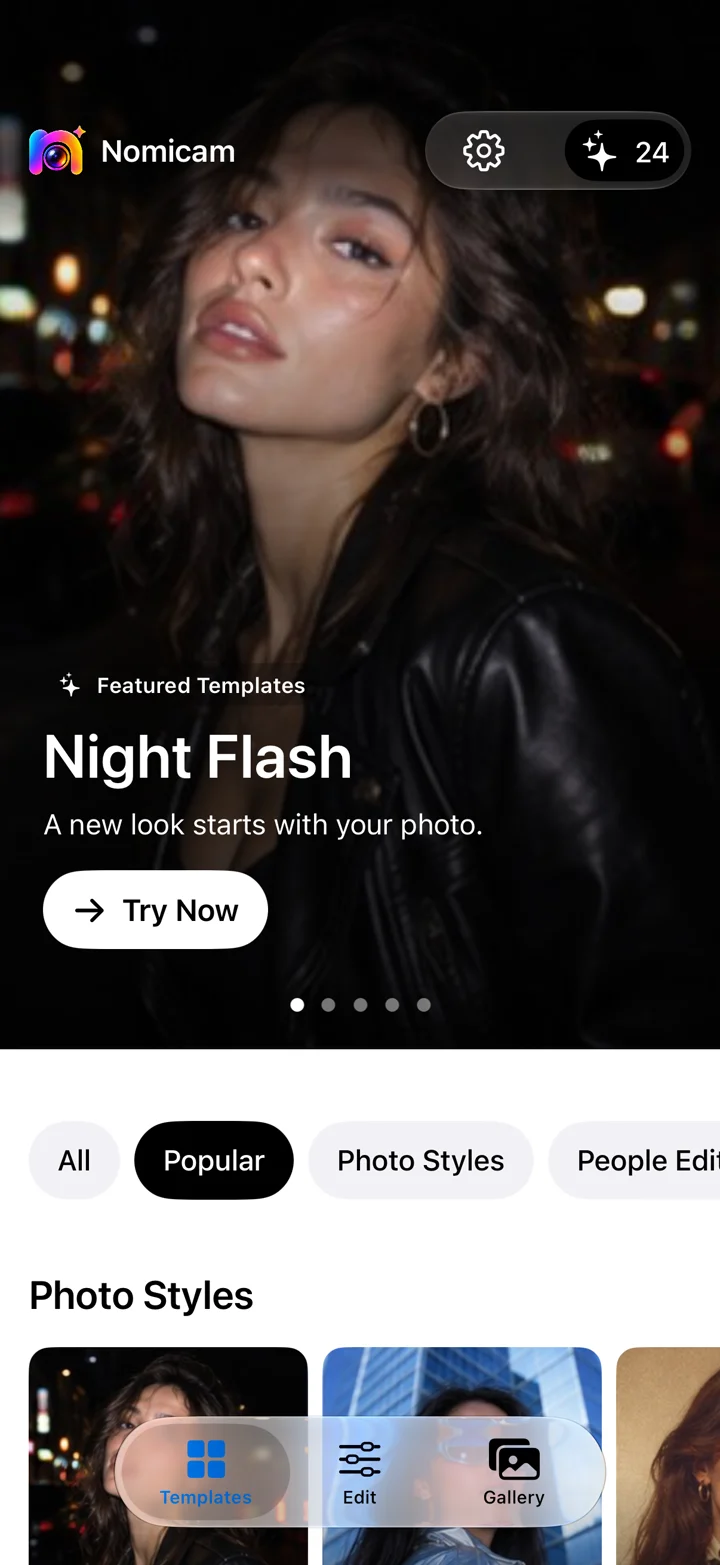
Nomicam is our AI photo editor, combining AI-powered templates with photo editing tools. Its public product presentation follows a focused sequence: choose a template, add a photo and refine the result.
The template-led experience gives people a starting point without asking them to select a model or write a detailed prompt. Editing tools provide a separate place to adjust the image.
It is a concrete example of how an AI capability can sit within a guided product experience.

A clear scope for the work ahead.
Start with the task your product needs to support and the stage you are at today. The engagement needs a defined endpoint, whether the next decision calls for a prototype or a more complete first version.
Define what will be demonstrated or delivered
Agree the core flow, the relevant states and the criteria for reviewing it. Identify whether AI responses are live or simulated and which application components belong in the scope.
Make responsibilities explicit
Identify who provides the content, example inputs, product decisions and required access. Development, testing, deployment and operation need named responsibilities, alongside an agreed feedback process.
Separate the build from its running costs
Model usage, hosting and other third-party services may affect the cost of operating a product. Their account ownership, billing and relationship to the engagement fee need to be established before commitments are made.
Agree the handover and what follows
Specify the files, code, access and documentation to be transferred, where applicable. Set out whether release work, maintenance and further iterations are included or require a separate arrangement.
Learn more about Gestures Studio ↗ and the perspective behind our work.
Monthly partnership
$7,500$10,500USD / month
Studio $7,500 + Growth $3,000 / month
For a few months of focused progress. The monthly plan suits ongoing product work and longer design sprints.
Lead Designer · Senior Designer · Account Manager
Work starts within 1 day of payment.
Cancel anytime.
Book a CallWeekly sprint
$2,250$4,000USD / week / 2 weeks
+ $3,000 / month for Growth
For a smaller feature, a focused website project or a shorter sprint. Choose a weekly engagement when the work needs a tighter horizon.
Save $500 with two weeks: $4,000 instead of $4,500.
Lead Designer · Senior Designer · Account Manager
Work starts within 1 day of payment.
Cancel anytime.
Book a CallAdd Growth to a studio plan
SEO, content strategy and content production, alongside your design team. Growth is billed monthly. Cancel anytime.
+$3,000 / month
AI Product Development Questions
What do you mean by AI-native product development?
On this page, AI-native describes a product in which AI contributes to the core task people use it for. For example, an AI photo editor uses AI to help create or transform an image. Product development connects that capability to the input, interface and actions around it.
How is this different from using AI tools to write code?
AI-native describes what the product does for its users. AI-assisted development describes how software is built. A team can use AI coding tools to build a product whose core function does not involve AI. The two terms describe different things.
Can we start with a prototype before building an MVP?
Yes. A prototype is the right first step when a central assumption needs testing. It examines the interaction or capability before you commit to a fuller product, and its findings set the next step.
What types of AI products can you help build?
Nomicam, our studio-owned AI photo editor, is one example of our product work. For a new engagement, share the intended user, core task and current stage so we can discuss the relevant scope.
How are AI usage and third-party costs handled?
AI usage, hosting and other services usually carry their own charges. The scope names the account holder, who pays and any allowance included.
What happens after the prototype or first version is delivered?
You choose the next stage from the findings. A prototype leads to a revised scope or a first build, and a first version sets the priorities for further work. Deployment, maintenance and continuing development need their own agreed responsibilities.
How much does an engagement cost, and how long does it take?
Choose $7,500/month for ongoing, multi-month work or $2,250/week for a focused feature or website engagement. A two-week sprint is $4,000. Both include a Lead Designer, Senior Designer and Account Manager, and you can cancel anytime. The optional Growth plan adds $3,000/month for SEO, content strategy and content production; it is billed monthly only, with either plan. Product scope and development responsibilities are agreed for your engagement; this is not an all-inclusive price for a complete application.
Platform support, model/API work, testing, source code and account ownership, release and support responsibilities need to be defined for each engagement. They are not established by the examples on this page.
What should your first version make possible?
Tell us who the product is for, what it should help them do and what you have explored so far. We can discuss the next useful step and whether Gestures is the right fit.